Kasus herleiten statt auswendig lernen
How much of the preposition business follows from one principle — and where the honest exceptions are.
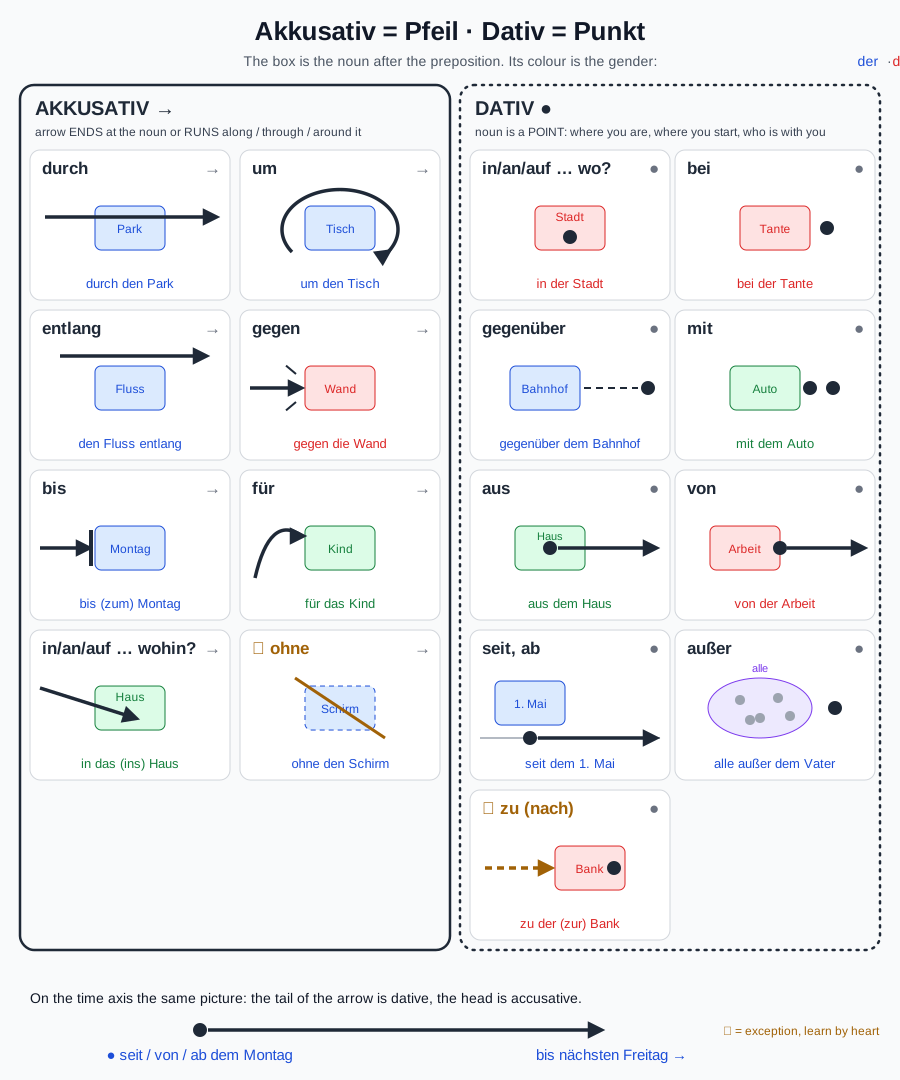
1. The principle
Akkusativ = arrow →
The noun is where a motion ends, or the line the motion follows: path, extent, direction, target.
Physics: the noun is the head of the vector or lies on its trajectory.
Dativ = point ●
The noun is a fixed reference point: where something is, where a motion starts, or what is with you.
Physics: the noun is a position, the tail of the vector, or a co-moving partner.
Why this is not a bogus rule — the history
Proto-Indo-European had eight cases. Germanic collapsed them, and the German Dativ is a merger of four old cases:
| Old case | Meaning | Survives in German as … |
|---|---|---|
| Locative | where? | bei, gegenüber, in … + wo? |
| Ablative | from where? | aus, von, ab, seit, außer |
| Instrumental | with what? with whom? | mit |
| Dative proper | to / for whom (recipient) | bare dative: Ich gebe dem Mann …; zu |
The Akkusativ was always the case of the direct object, of the goal of motion and of extent. German still uses a bare accusative for extent: den ganzen Tag arbeiten, einen Kilometer laufen, jeden Morgen.
Latin has the identical system — in urbe (abl., in the city) vs. in urbem (acc., into the city). This is deep Indo-European structure, not a German whim.
Mapping onto Finnish
| Suomi | Deutsch → Akk |
|---|---|
| mihin? minne? illatiivi, allatiivi (-Vn, -lle) | ins Kino — elokuvateatteriin |
| mitä pitkin? kautta? prolatiivi (-tse), läpi, ympäri | durch den Wald — metsän läpi |
| Suomi | Deutsch ● Dat |
|---|---|
| missä? inessiivi, adessiivi (-ssa, -lla) | im Kino — elokuvateatterissa |
| mistä? elatiivi, ablatiivi (-sta, -lta) | aus dem Haus — talosta |
| millä? kenen kanssa? adessiivi, kanssa | mit dem Zug — junalla |
| kenelle? allatiivi for a person | dem Mann geben — miehelle |
2. Deriving the fixed-case prepositions
| Akk → | image |
|---|---|
| durch | trajectory through |
| um | trajectory around |
| entlang | trajectory along |
| bis | end point of the arrow →| |
| gegen | arrow hits / points at |
| für | arrow aimed at a target / beneficiary |
| Dat ● | image |
|---|---|
| aus | start point inside ●→ |
| von | start point at the surface ●→ |
| ab | start point (place / time) ●→ |
| seit | start point in time ●→ until now |
| bei | position next to |
| gegenüber | position facing ● · ● |
| mit | co-moving partner ●● |
| außer | point outside a set (from aus) |
Pairs that check the principle
- gegen vs. gegenüber: same root. gegen is a direction, gegenüber a fixed position opposite.
- seit … bis: tail and head of the same time arrow — seit dem Montag ●———→ bis nächsten Freitag. Same with von … bis.
- außer is derived from aus (Old High German ūzar from ūz) → point outside.
- entlang after the noun is a pure path: den Fluss entlang.
The honest exceptions
| Word | Problem | Fix |
|---|---|---|
| ⚠ zu | goal of motion, yet Dat | zu goes to people and institutions (zum Arzt, zur Bank, zu meiner Mutter): the old recipient dative — Finnish -lle to a person (lääkärille). |
| ⚠ nach | goal of motion, yet Dat | Practically invisible: as a direction it goes with cities and countries without article (nach Zürich, nach Finnland, nach Hause). When an article shows up, nach means after (nach dem Essen) — a position on the time axis ✓. |
| ⚠ ohne | no arrow, yet Akk | Pure memory: ohne is the opposite of mit, so it takes the opposite case. |
Score: of the 17 common fixed-case prepositions, 14 follow from the arrow / point picture, nach is invisible in practice, and only zu and ohne must be memorized.
Genitiv-Präpositionen ◆
wegen, während, trotz, statt, innerhalb, außerhalb … — not derivable (mostly fossilized nouns: statt = "Stätte, place"). Recognize them; in speech they take the Dativ anyway.
3. Deriving the case in verbs with prepositions
With Dat-prepositions (aus, bei, mit, nach, von, zu) or Akk-prepositions (durch, für, gegen, ohne, um) there is nothing to derive. The only real decision is for Wechselpräpositionen used abstractly — and the picture still works for the mental image:
Mind aimed at / moving to a target →
| warten auf | gaze aimed at the bus |
| hoffen, sich freuen auf | aimed at the future |
| sich verlassen auf | leaning onto |
| achten, aufpassen auf | attention aimed at |
| antworten, reagieren auf | response sent to |
| sich konzentrieren auf | focus aimed at |
| denken, glauben an | thought sent to |
| sich erinnern an | memory travels back to |
| sich gewöhnen, anpassen an | moving towards |
| sich wenden an | turning towards |
| sich verlieben in | falling into |
| geraten in | getting into a situation |
| übersetzen in | moving into another language |
| … über anything | mind sweeps over a topic (a path!) |
Located at, standing on, under, in front of ●
| bestehen auf | standing firmly on it |
| basieren, beruhen auf | resting on it |
| arbeiten an | located at the workbench |
| teilnehmen an | being part of it, inside it |
| leiden an | the illness sits in you |
| sterben an | the cause located in the body |
| zweifeln an | doubt located at a point |
| erkennen an | identified at a feature |
| Interesse an | interest located in |
| leiden unter | sitting under a weight |
| verstehen unter | what lies under a word |
| Angst haben vor | standing in front of a threat |
| warnen, schützen vor | the threat is the source |
| fliehen vor | running away from (tail ●) |
Compact rules that fall out of this
- über abstract → always Akk (a path over the topic, like durch).
- auf abstract → Akk, except the three verbs of standing / resting on: bestehen, basieren, beruhen.
- vor and unter abstract → always Dat (positions; with vor the danger is the source — Finnish elative: suojata jostakin, paeta jostakin).
- in → Akk (going into a state); sich irren in — the error is located in the person.
- an → the arrow / point test: thinking, believing, remembering, adapting = arrow; working, taking part, suffering, dying, doubting = located there.
The Finnish cross-check
Translate a Wechselpräposition verb into Finnish and listen to the case:
Illatiivi (johonkin) → Akk, almost always:
- uskoa johonkin = glauben an
- luottaa johonkin = sich verlassen auf
- rakastua johonkin = sich verlieben in
- tottua johonkin = sich gewöhnen an
- vastata johonkin = antworten auf
- keskittyä johonkin = sich konzentrieren auf
- joutua johonkin = geraten in
- ⚠ osallistua johonkin = teilnehmen an
- ⚠ kuolla johonkin = sterben an
Elatiivi (jostakin) with vor / unter / an → Dat:
- suojata jostakin = schützen vor
- paeta jostakin = fliehen vor
- kärsiä jostakin = leiden an / unter
4. Which preposition? (partly derivable)
The choice of preposition is the least derivable part, but three tricks cover a good share.
Take the spatial image literally: ab-hängen von (hang down from), bestehen aus (made out of), Angst vor (standing in front of), leiden unter (under a load), sich kümmern um (wrapping your care around), sprechen über (flying over the topic), warten auf (looking out onto the road), sich verlieben in (falling into).
Prefix echo — a separable prefix often repeats the preposition:
| Verb | Echo |
|---|---|
| aufpassen auf | auf – auf |
| anpassen an | an – an |
| einmischen in, einwilligen in | ein ≈ in |
| abhängen von, abraten von | ab ≈ von (both "away from") |
Finnish elatiivi ↔ German von is a frequent pair: riippua jostakin = abhängen von, haaveilla jostakin = träumen von, pitää jostakin = halten von, kertoa jostakin = erzählen von, toipua jostakin = sich erholen von. (Not universal: kiinnostua jostakin = sich interessieren für.)
Everything not covered by these tricks is vocabulary — learn warten auf + Akk in one breath, like a Finnish verb with its case.